What Is Female Genital Mutilation (FGM)?
Female Genital Mutilation (FGM) refers to all procedures involving the partial or total removal of the external female genitalia or other injury to the female genital organs for non-medical reasons. FGM has no health benefits and causes severe physical, psychological, and social harm to girls and women. It is internationally recognised as a violation of human rights. Learn More Here
 FGM as a Human Rights Violation
FGM violates fundamental human rights protected under Nigerian and international law, including:
- The right to dignity of the human person
- The right to health and bodily integrity
- The right to freedom from torture, cruel, inhuman, or degrading treatment
- The rights of the child to protection, survival, and development
Because of these violations, FGM is criminalised under Nigerian law.
National Legal Framework: VAPP Act
At the national level, the Violence Against Persons (Prohibition) Act, 2015 (VAPP Act) criminalizes FGM and other forms of gender-based violence. The Act provides a legal basis for states to domesticate and enforce protections against harmful practices like FGM.
However, laws are enforced at state level, making state-specific VAPP laws critically important.
FGM Prohibition Across Nigerian States
Several states in Nigeria have enacted laws that explicitly prohibit FGM, either through:
- State versions of the VAPP Law, or
- Specific anti-FGM or child protection laws
States including Oyo, Ekiti, Osun, Lagos, Ebonyi, Rivers, Cross River, and others have domesticated laws that criminalize FGM. These laws affirm that culture, religion, or tradition cannot justify FGM.
Special Focus: Oyo State VAPP Law and FGM
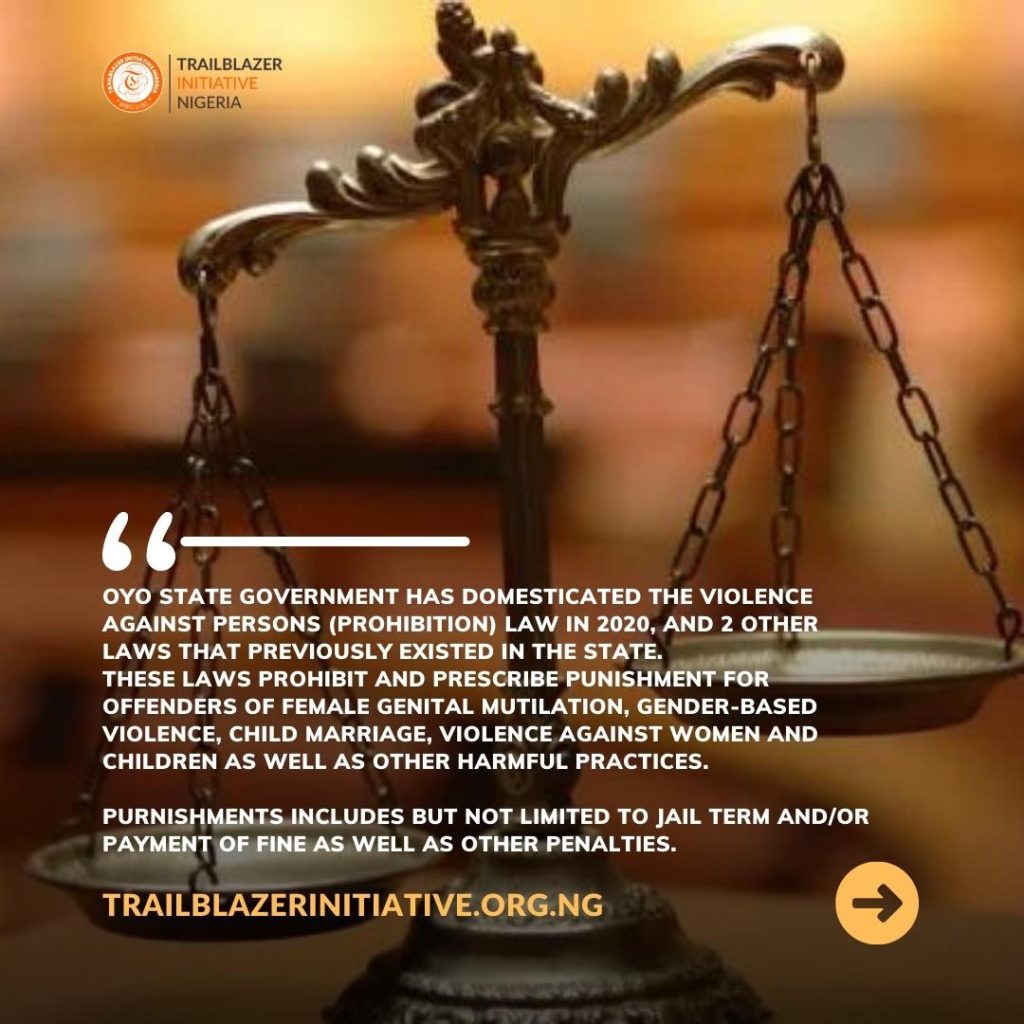
The Oyo State Violence Against Persons Prohibition (VAPP) Law provides clear and strong legal provisions against FGM.
What the Oyo State VAPP Law Says
Under the law:
(1) The female genital mutilation of a girl child or woman is hereby prohibited.
(2) Any person who performs FGM or engages another person to carry it out commits an offence and is liable on conviction to:
- Imprisonment not exceeding 4 years, or
- A fine not exceeding ₦500,000, or
- Both imprisonment and fine.
(3) Any person who attempts to commit FGM commits an offence and is liable on conviction to:
- Imprisonment not exceeding 2 years, or
- A fine not exceeding ₦200,000, or
- Both imprisonment and fine.
(4) Any person who incites, aids, abets, or counsels another to commit FGM commits an offence and is liable on conviction to:
- Imprisonment not exceeding 4 years, or
- A fine not exceeding ₦500,000, or
- Both imprisonment and fine.
(5) Any person who receives or assists someone who has committed FGM, knowing that the offence has been committed, is an accessory after the fact and is liable on conviction to:
- Imprisonment not exceeding 2 years, or
- A fine not exceeding ₦200,000, or
- Both imprisonment and fine.
This means FGM is illegal at every stage — planning, performing, encouraging, hiding, or assisting offenders.
What This Means for Communities in Oyo State
- FGM is not a private family matter — it is a criminal offence.
- Parents, caregivers, traditional cutters, health workers, and community members can all be held accountable.
- Silence or protection of offenders is also punishable under the law.
- Survivors are entitled to protection, care, and justice.