PRESS RELEASE
For Immediate Release
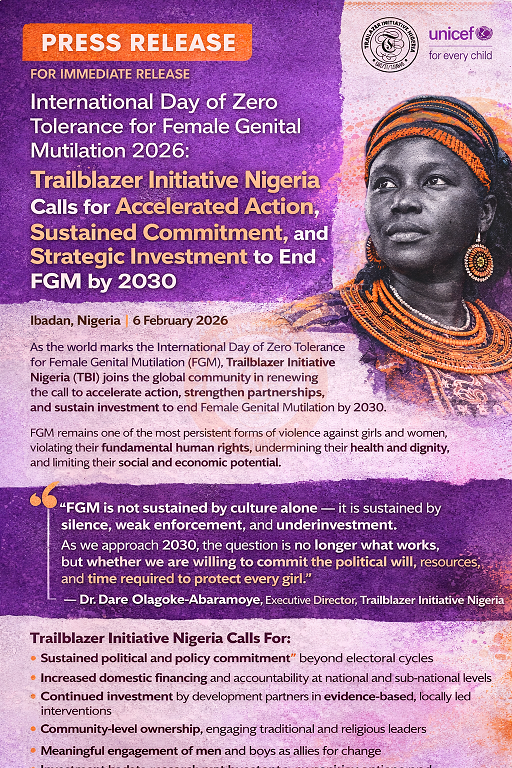
International Day of Zero Tolerance for Female Genital Mutilation 2026: Trailblazer Initiative Nigeria Calls for Accelerated Action, Sustained Commitment, and Strategic Investment to End FGM by 2030
Ibadan, Nigeria | 6 February 2026
As the world marks the International Day of Zero Tolerance for Female Genital Mutilation (FGM), Trailblazer Initiative Nigeria (TBI) joins the global community in renewing the call to accelerate action, strengthen partnerships, and sustain investment to end Female Genital Mutilation by 2030.
FGM remains one of the most persistent forms of violence against girls and women, violating their fundamental human rights, undermining their health and dignity, and limiting their social and economic potential. Despite decades of advocacy and measurable progress in some regions, current trends show that the pace of change is not fast enough to meet global commitments.
Recent evidence indicates that while national prevalence among adult women has declined, FGM is increasingly being carried out on younger girls, often before the age of five. This shift highlights the urgent need to move beyond short-term interventions toward long-term, well-funded, and community-driven solutions.
“FGM is not sustained by culture alone — it is sustained by silence, weak enforcement, and underinvestment,” said Dr. Dare Olagoke-Adaramoye, Executive Director of Trailblazer Initiative Nigeria.
“As we approach 2030, the question is no longer what works, but whether we are willing to commit the political will, resources, and time required to protect every girl.”
Globally, over 230 million girls and women are living with the consequences of FGM, while millions more remain at risk each year. The economic and health costs of treating FGM-related complications run into billions of dollars annually, yet evidence shows that prevention is far more cost-effective, saving lives while generating long-term social and economic benefits.
In Nigeria, FGM cuts across ethnic, religious, and geographic lines, driven by harmful social norms, misinformation, and gender inequality. Emerging hotspots among younger age groups underscore the importance of early intervention, community engagement, and enforcement of existing laws, including the Violence Against Persons (Prohibition) Act and relevant state-level legislation.
To achieve zero tolerance in practice — not just in principle — Trailblazer Initiative Nigeria calls for:
- Sustained political and policy commitment beyond electoral cycles
- Increased domestic financing and accountability at national and sub-national levels
- Continued investment by development partners in evidence-based, locally led interventions
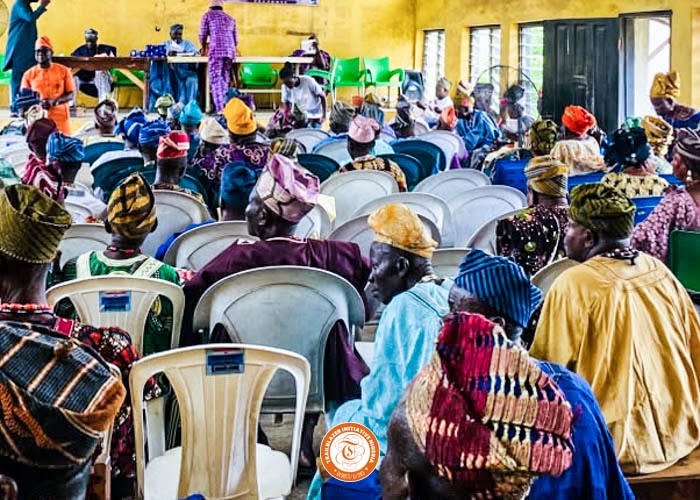
- Community-level ownership, engaging traditional and religious leaders
- Meaningful engagement of men and boys as allies for change
- Investment in data, research, and learning to ensure interventions reach the most at-risk girls
For more than a decade, Trailblazer Initiative Nigeria has worked alongside communities, young people, women leaders, and partners — including UNICEF — to challenge harmful norms, amplify survivor voices, strengthen child protection systems, and support girls to live free from violence.
As the world marks this important day in 2026, TBI reaffirms its commitment to ensuring that no girl is left behind, and that progress toward ending FGM is faster, fairer, and irreversible.
“Ending FGM by 2030 is still possible,” Dr. Olagoke-Adaramoye added.
“But it will only happen if we act with urgency, invest with intention, and stand firm in our commitment to the rights and futures of girls.”
Media Contact:
Trailblazer Initiative Nigeria
📧 Email: info@trailblazerinitiative.org.ng
🌐 Website: www.trailblazerinitiative.org.ng
📱 Social Media: @TrailblazerNG