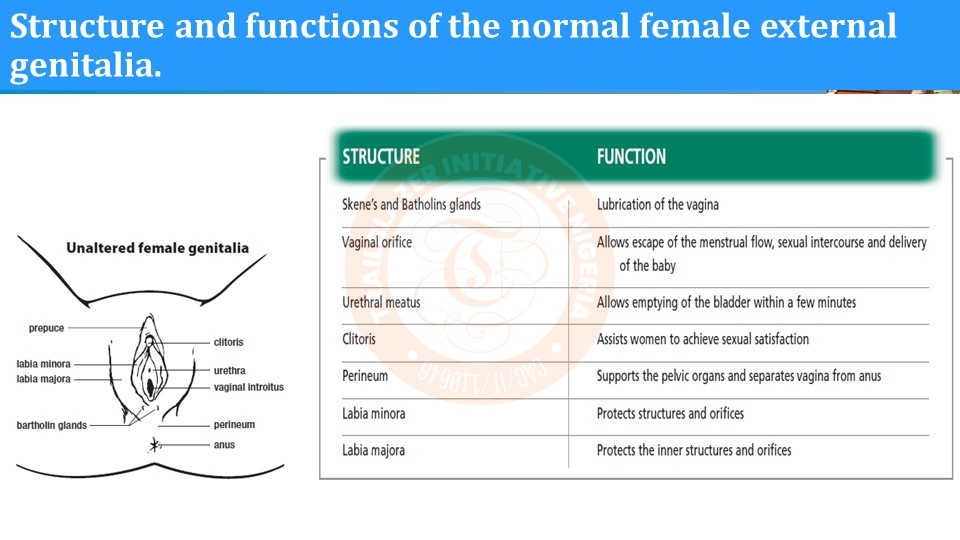
Female Genital Mutilation (FGM) refers to all procedures involving the partial or total removal of the external female genitalia or other injuries to the female genital organs for non-medical reasons (WHO, 2020).
 It is recognized internationally as a violation of human rights, reflecting deep-rooted gender inequalities and harmful traditional practices. The practice is prevalent in parts of Africa, the Middle East, and Asia, with Nigeria being one of the countries with a high burden of FGM cases (UNFPA, 2022). Despite global efforts to eradicate FGM, cultural, religious, and economic factors sustain its prevalence.
FGM is classified into four main types:
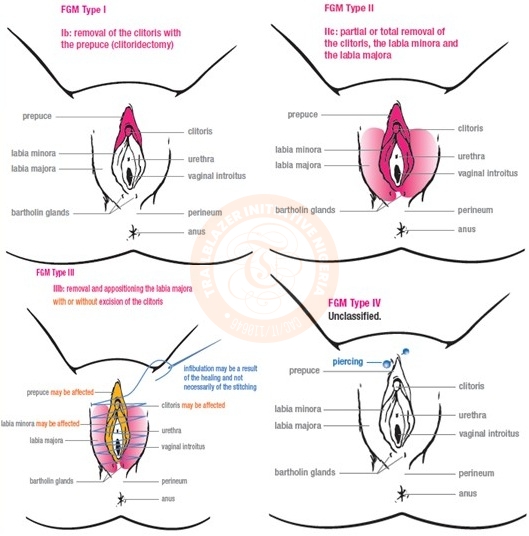 Type I: Clitoridectomy: Partial or total removal of the clitoris (a small, sensitive and erectile part of the female genitals) and, in very rare cases, only the prepuce (the fold of skin surrounding the clitoris).
- Type II: Excision: partial or total removal of the clitoris and the labia minora, with or without excision of the labia majora (the labia are “the lips” that surround the vagina).
- Type III: Infibulation: Narrowing of the vaginal opening through the creation of a covering seal. The seal is formed by cutting and repositioning the inner, or outer, labia, with or without removal of the clitoris.
- Type IV: Unclassified: includes all other harmful procedures to the female genitalia for non-medical purposes, e.g. piercing the clitoris, cauterisation, cutting the vagina, inserting corrosive substances.
“Massage”: applying Vaseline/herbal concoctions/Mentholatum/or hot water to the clitoris and pushing it back into the body or making it fall off. Some people use roasted palm-fruits to burn the Clitoris (common in Imo State). Aim is to curb sexual appetites by preventing “itching” Seen as an alternative to FGM, since cutting is not involved – (WHO, 2021).
Who performs FGM
The practice of Female Genital Mutilation (FGM) is carried out by a range of individuals within communities.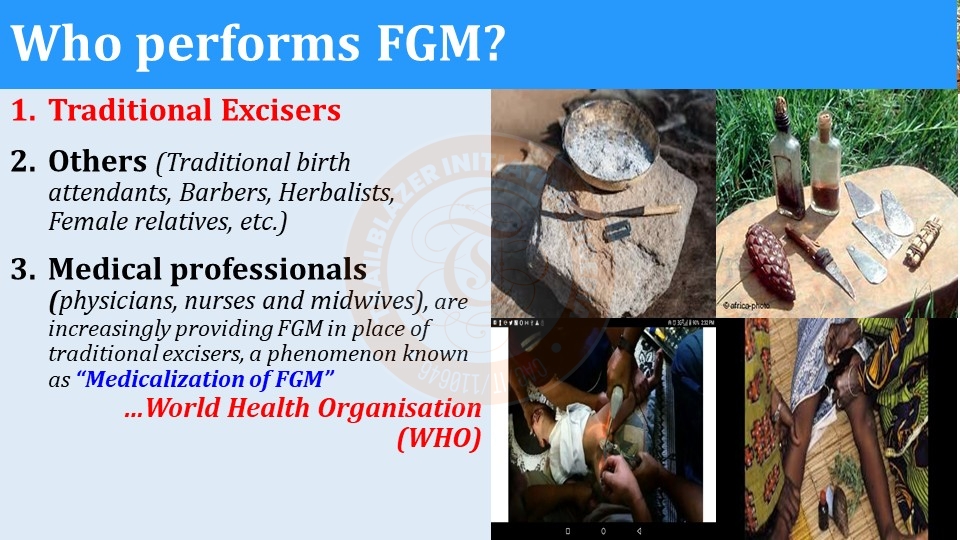
- Traditionally, it is performed by excisers (popularly called “Olola” in Yoruba culture) using crude and unsterilized tools, often in unsanitary conditions that increase the risk of infections, excessive bleeding, and long-term complications, including difficulties during childbirth.
- In some cases, other community actors—such as traditional birth attendants, barbers, herbalists, or even female relatives—also perform the procedure, perpetuating its normalization at the household level.
- Alarmingly, there is a growing trend of medical professionals (physicians, nurses, and midwives) carrying out FGM in place of traditional excisers, a phenomenon referred to by the World Health Organization (WHO) as the “medicalization of FGM.” While some view this as a safer alternative, WHO strongly warns that medicalization legitimizes the practice and continues to expose women and girls to significant health and human rights violations. Cultural, religious, and social norms remain key drivers of its persistence despite these well-documented risks.
FGM is deeply rooted in gender-based discrimination and is often considered a rite of passage for girls transitioning into womanhood. In many societies, women who have not undergone the procedure may face social ostracization, difficulty finding a marriage partner, and even rejection by their families. Understanding the conceptual framework of FGM provides a foundation for developing interventions that target the root causes of the practice. Education, awareness campaigns, legal frameworks, and community engagement are crucial in dismantling the harmful beliefs that support FGM.